Optimising Kiosks for Commercial Success

In today's dynamic retail landscape, every customer touchpoint is an opportunity to enhance experience and drive revenue. Shopping centres compete for visitor attention, often relying on digital tools to stand out. Interactive kiosks appear ubiquitous, but are yours truly working for you, or are they underutilised assets?
Many centres have installed kiosks as a quick fix, overlooking their profound strategic potential. With the right design and operational strategy, these unassuming screens can become powerful engines for enhancing shopper experience, boosting retailer revenue, and optimising operational efficiency. This guide provides actionable insights for transforming your kiosk deployment into a high-performing commercial asset.
Redefining the Kiosk's Role: From Guide to Growth Engine
A kiosk is more than a digital directory; it is a direct extension of your marketing and operations teams. When strategically deployed, it can actively contribute to commercial growth. Studies show self-service kiosks can increase average order value (AOV) by 15-30% on average, thanks to factors like reduced social pressure and compelling visual merchandising. For a shopping centre, this translates directly to encouraging more spending by seamlessly guiding shoppers to stores, promotions, and essential services.
Kiosks equipped with Living Map technology offer unparalleled insights. Phil Rae, our Chief Product and Technology Officer, notes, "We can quantify what people are searching for on the map, what routes are generated. With kiosks, we know what people are searching for at what particular point in space — so that infers what people are struggling to find. That’s quite rich data." This rich data allows centres like Metrocentre and Trafford Centre to adapt their strategies based on real-world visitor behaviour, moving beyond mere navigation to informed growth.
Strategic Design for Shopper Psychology & Optimal UX
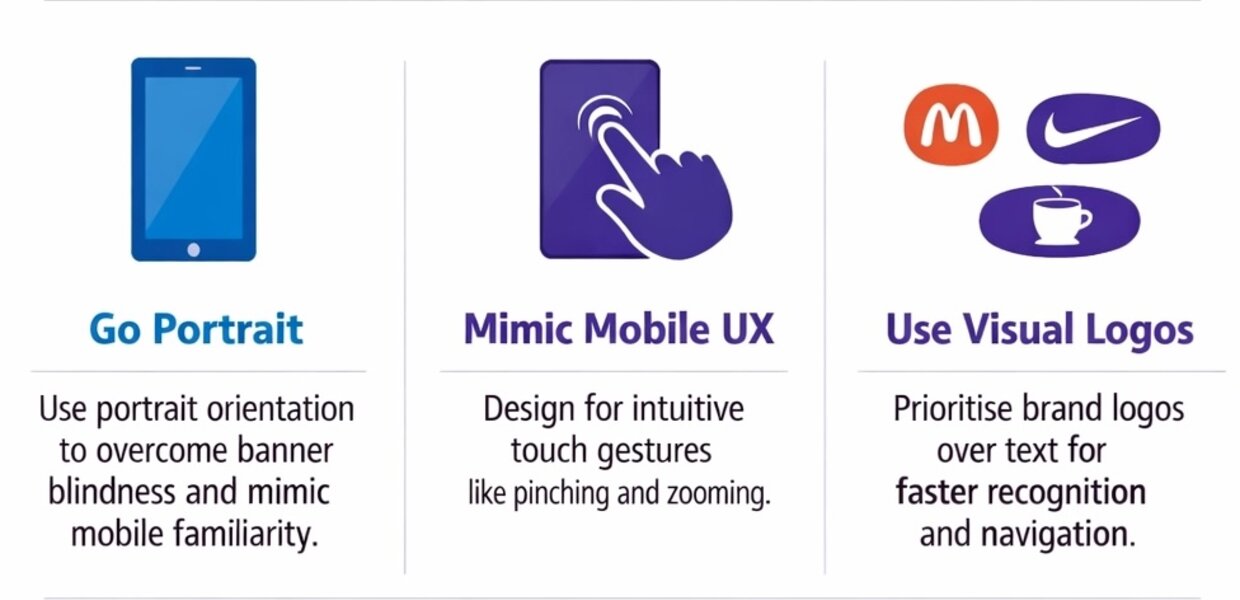
Intuitive design must always take precedence over feature overload. Your kiosks should effortlessly guide, not confuse. A crucial, yet often overlooked, design principle pertains to screen orientation. "Making a screen portrait rather than landscape is important," Phil Rae advises, "because people become banner-blind to landscape TVs." A portrait orientation naturally mimics mobile device use, draws the eye more effectively, and optimises content display for a more familiar experience.

Making a screen portrait rather than landscape is important because people become banner-blind to landscape TVs.
Emulating familiar interfaces is paramount for successful engagement. As Phil highlights, "People are much more accustomed to interacting with screens, just as they’re accustomed to maps on their phones that they can pinch and zoom." This underscores the need for clear calls to action, minimal yet impactful text, and prominent visual cues such as brand logos rather than mere text names. Accessibility features must be standard, ensuring every visitor enjoys a frictionless experience
Beyond Wayfinding: Operational Efficiency & Cost Savings
Well-designed kiosks significantly unburden staff, allowing them to focus on higher-value customer interactions. By reducing the volume of directional queries, staff can deliver more personalised service, improving overall visitor satisfaction. This redistribution of effort enhances the human element of your centre, rather than replacing it.
Operational data from kiosks offers precise insights into navigation "struggle areas." This enables management to make targeted improvements to physical signage or pathway design, saving long-term operational costs and preventing recurring visitor frustration. For example, Phil describes how Living Map kiosks support staff, not replace them: "It shouldn’t be ‘scan this QR code or download this app, and it’s on you to figure it out.’ It should be a handoff, an interaction." This approach, exemplified at locations like Canary Wharf, empowers security and guest services teams, transforming a simple request into a positive, collaborative experience.
The "Living" Kiosk: Upkeep, Adaptation & Long-term ROI
A kiosk is a dynamic asset; its ongoing management is crucial for sustained ROI. The "map is never done" concept is central to effective digital wayfinding. A robust Map Management System (MMS) is indispensable, empowering internal teams to make real-time updates. This includes managing store closures, adapting routing for events, or implementing crowd management strategies, as is vital in busy cultural venues or large retail environments. Prompt updates ensure accurate information and maintain visitor trust.
Crucially, every kiosk strategy must incorporate analytics from the outset. Kiosks are rich data sources. Living Map's analytics dashboards provide insights into search patterns, popular routes, and time-of-day usage. This continuous feedback loop allows centres to refine physical layouts, optimise promotional strategies, and ensure the kiosk network delivers maximum value. Investing in a solution built for longevity and adaptability, as advocated by industry experts, ensures your technology investment continues to yield returns. A 2024 JLL Global Retail Research report indicates that digital-first shopping centres experience a 15-20% increase in dwell time, directly correlating to increased engagement and sales.
Please get in touch if you want to discuss your space and/or need some advice on digital wayfinding - we'd love to help.
Request a demo
Experience the power of our mapping, wayfinding, and asset tracking technology for yourself. See how our software can enhance your facility.