Digital wayfinding in shopping centre redevelopment plans

Shopping centre redevelopment is back on the agenda. Across the UK and worldwide, owners are reinvesting in their assets. They are adding new anchors and updating malls. They are expanding leisure space and refreshing public areas. The business case is usually built on tenant mix, footfall and dwell time.
The map is the part that rarely makes it into the redevelopment budget. Yet for most visitors, the map is how they experience everything you have just built. If the digital wayfinding is out of date, hard to use, or simply absent, a share of your capital investment goes unseen. People cannot dwell in a food hall they never found.
At Living Map, we have spent over a decade building digital maps and wayfinding for complex places. These include Trafford Centre, Metrocentre, Lakeside, and most recently, Derbion. That experience has taught us that redevelopment is the single best moment to get wayfinding right, for three reasons: the disruption makes navigation harder, the investment raises visitor expectations, and the data becomes more valuable precisely when the asset is changing.
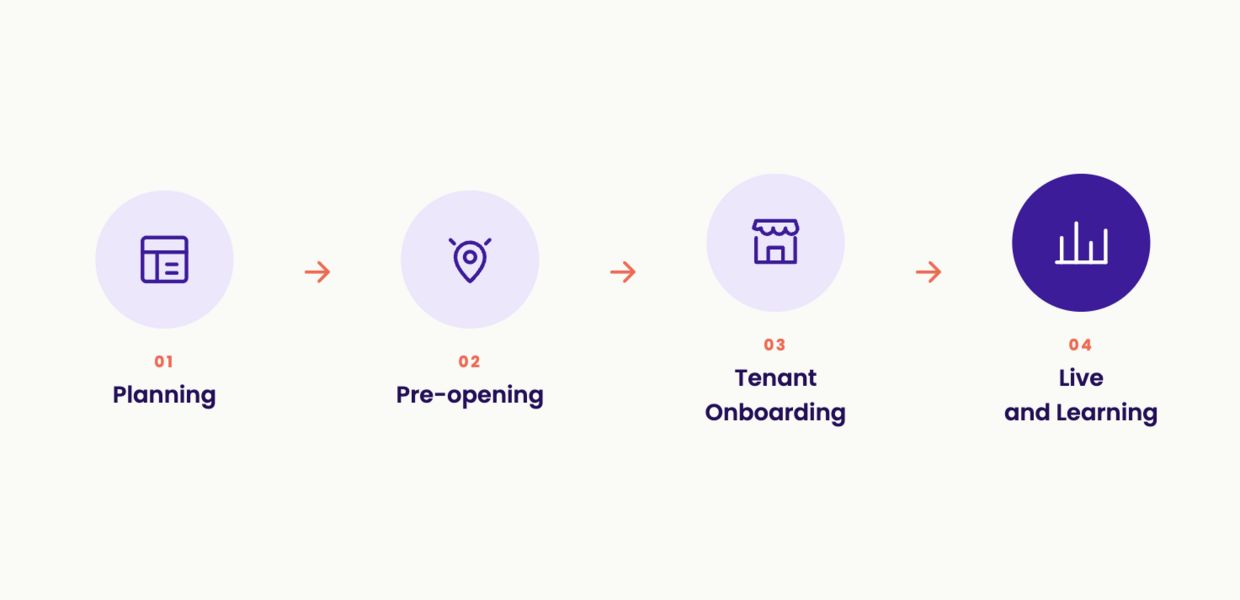
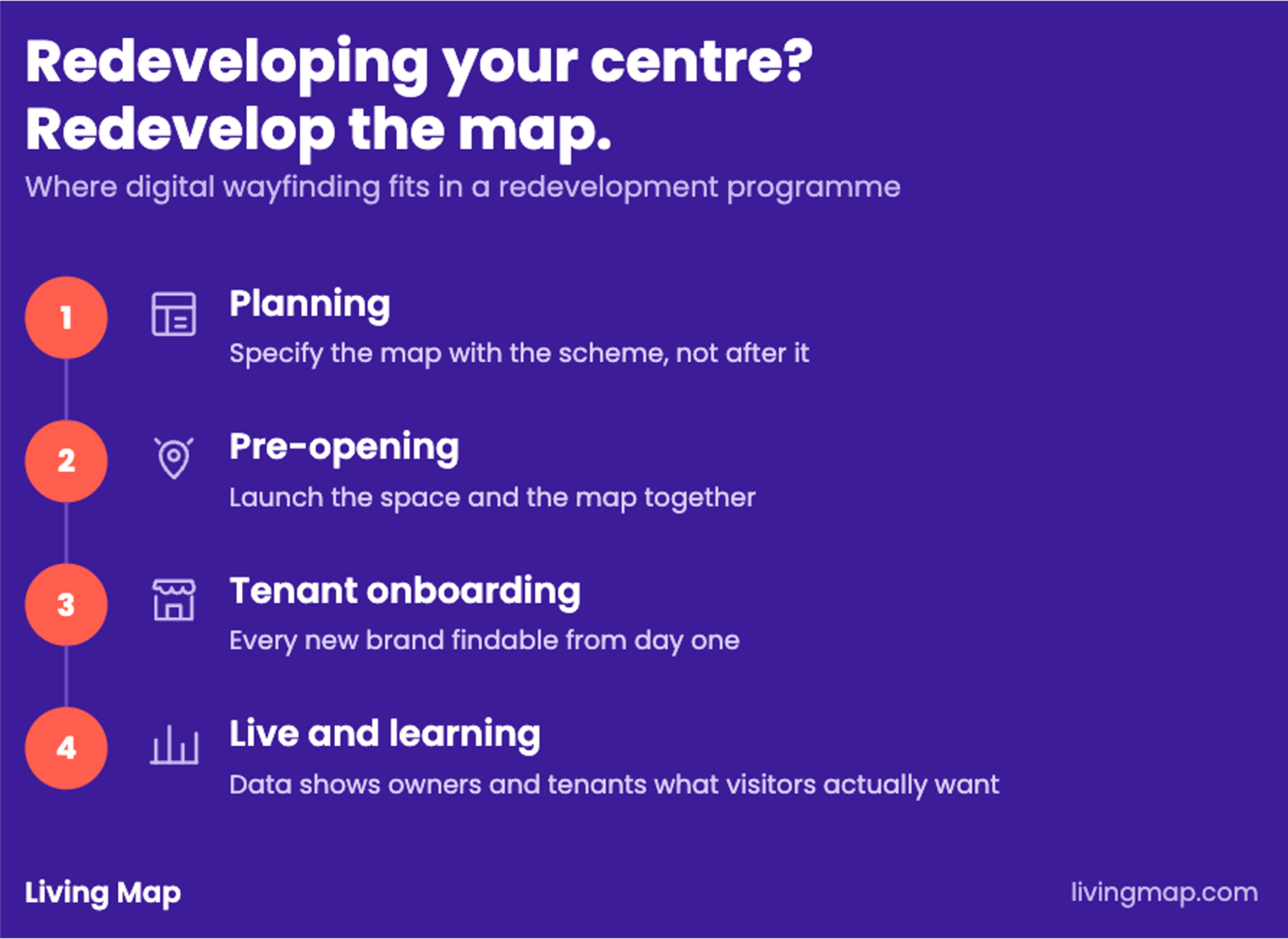
During planning: a live map of a changing asset
A redevelopment programme is a long period in which the centre never quite matches the signage. Entrances close, units move, hoarding goes up, walking routes change week by week.
A digital map handles this in a way printed guides and static signage cannot. With Living Map's Map Manager System, the centre team updates the map themselves: close a route, move a store, add a temporary entrance, and every kiosk, mobile and web map reflects it immediately. During construction that is an operational tool, not a marketing one. It reduces the directions burden on centre staff and keeps accessibility routes accurate, which matters most for the visitors with the least tolerance for a wrong turn.
Planning teams also get something harder to find elsewhere: evidence. Wayfinding search data shows what visitors look for and where they give up. That is useful input for leasing conversations and layout decisions while the scheme is still on paper.
Pre-opening: launch the space and the map together
Most centres treat the map as an afterthought, something to update once the ribbon is cut. The stronger move is to treat the digital map as part of the launch.
A phased opening is a navigation problem by definition. Half the scheme is trading, half is behind hoarding, and your launch marketing is actively sending people in. A current, accurate digital map lets visitors find the new opening on day one, lets your marketing team link every campaign to a live location, and gives the operations team one place to manage the constant changes of opening weeks.
There is a brand argument too. If you have spent tens of millions making the physical environment better, the digital front door should match it. A dated map, or a PDF floorplan, sits oddly next to a repositioned asset. A well-designed digital map is one of the cheaper ways to make the whole scheme feel as considered as the architecture.
Tenant onboarding: findable from day one
New tenants judge a landlord quickly. One of the simplest things an owner can offer an incoming brand is this: from the day you open, every visitor who searches for you can walk straight to your door.
Digital wayfinding turns tenant onboarding into a repeatable process. The unit appears on the map before opening, marked as coming soon if you choose. On opening day it goes live across kiosk, mobile and web. And from then on, the tenant shows up in the search and routing data, so both sides can see how discoverable the store actually is.
That data is the step change. Owners have long had footfall counts at entrances. Wayfinding analytics add intent: what people searched for, what they could not find, which routes they took, where dwell happens. For the asset team, that informs leasing, commercialisation and layout. For tenants, it is evidence a landlord can bring to a rent review or a renewal conversation. Few things support a landlord and tenant relationship like shared data about what visitors actually want.
Our advice about digital maps for owners and operators of shopping malls
Phil Rae leads product at Living Map and has worked on mapping for some of the most complex visitor environments in the world, from UK shopping centres to St Pancras train station and The Met in New York. His advice for anyone planning a redevelopment:
- Put the map in the capex conversation, not the marketing budget. "Wayfinding gets treated as a nice-to-have because it is bought late. If it is specified alongside the physical scheme, it costs a fraction of one per cent of the project and it is the layer visitors actually touch."
- Choose a map your own team can run. “The test is simple: when a unit changes hands on a Friday afternoon, can your team update every screen in the building before Saturday trading? If the answer involves a support ticket to a supplier, the map will always be out of date.”
- Design for the most complex situations, not the ‘easy’ launch photo. "Anyone can navigate a finished centre on a quiet Tuesday. The map earns its keep during construction, phased openings and Christmas. Plan for those."
- Treat the data as part of the return on the redevelopment. "You are about to change how millions of people move through your asset. If you are not measuring what they search for and where they go, you are guessing at whether the scheme worked."
As Phil put it when Derbion adopted Living Map: “Our focus is on making it easier for visitors to navigate the centre day-to-day, while the centre's management team can use our platform to keep maps accurate, current, and reflective of changes as they happen.”
Proven in complex environments
Living Map runs the digital wayfinding at some of the UK's largest retail destinations, including Trafford Centre, Metrocentre and Lakeside, and Derbion is the latest centre to adopt the platform. The same technology runs at St Pancras and The Met Museum. These are not simple buildings, and that is the point: wayfinding earns its value where navigation is genuinely hard.
If a redevelopment, refurbishment or repositioning is on your roadmap, it is worth a conversation early, while the map can still be part of the plan rather than a retrofit.
Request a demo
Experience the power of our mapping, wayfinding, and asset tracking technology for yourself. See how our software can enhance your facility.